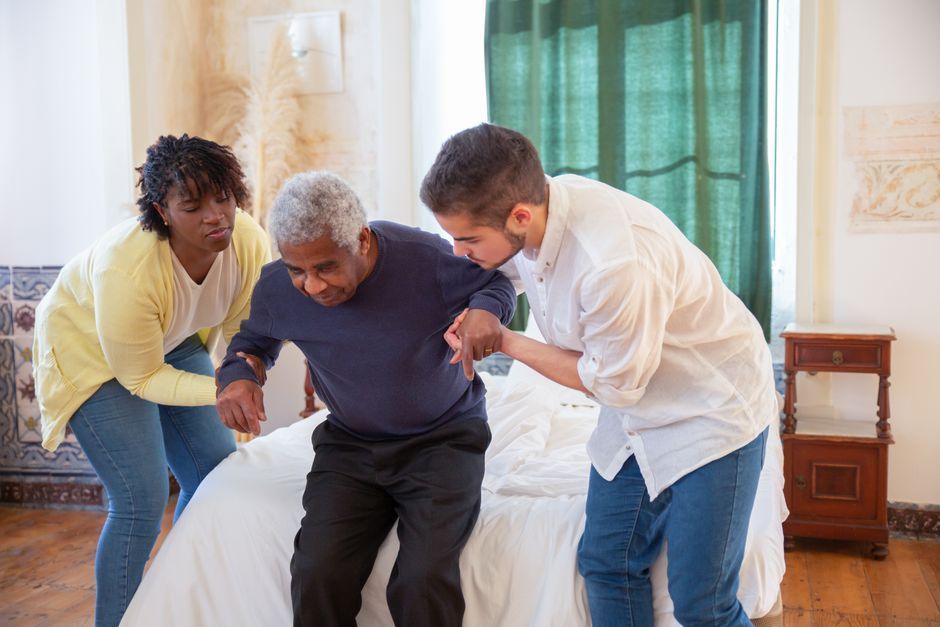
Getting Someone in Wheelchair Down From a Second or Third Floor Apartment
Two trained staff and a motorized stair chair, seated and belted the whole way down. That is $200 a visit , and it is what gets somebody out of a second or third floor apartment when they cannot walk the stairs. The one thing that stops us is a tight turn, so tell us on the phone whether the staircase turns, because we would both rather know before we arrive.
Why this is a Massachusetts problem
Three deckers. Brockton, Worcester, Lowell, Dorchester, Somerville and half the triple deckers in the state were built a century before anybody thought about elevators. The staircase is narrow, it usually turns at a landing, and it is often the only way in or out. There is no room for a ramp and nowhere to put one.
So a person on the third floor who stops being able to manage stairs does not just lose the stairs. They lose appointments, they lose the ability to leave at all, and the family starts talking about a nursing home for a reason that is architectural rather than medical.
Do not carry them yourselves
This is the part worth being blunt about. Two family members carrying a parent down a turning staircase is the most common way this goes wrong, and the person who gets hurt is usually not the one being carried. Backs, knees and a grip that fails on the landing. Now there are two people who need help and one of them is underneath the other.
A stair chair works because the weight is on the machine and the tracks, not on anybody's arms, and because the person stays seated and belted instead of being held.
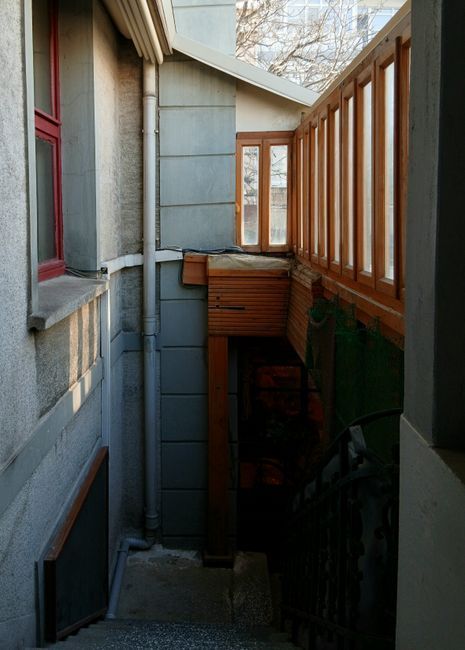
The turn at the landing is the thing to measure. It decides more than the number of steps does.
Measure three things before you call
- The narrowest point, wall to wall or wall to banister. Measure it, do not estimate it. A tape measure and thirty seconds saves everyone a wasted trip.
- Whether it turns, and if so whether there is a flat landing at the turn or wedge shaped steps going around it. Wedge shaped steps are the hard case.
- How many steps in total, and how many in each run between landings.
Take a photo from the bottom looking up and another from the top looking down and have them ready. We will tell you on the phone whether this works, and if it does not we will say so rather than send two people out to find out.
Please do not call 911 for this
If someone is injured or in distress, call 911, always. But a planned trip down the stairs to a scheduled appointment is not an emergency, and fire departments across Massachusetts are now saying so out loud. Several communities have moved to start charging for non emergency lift assists, with proposed fees in the hundreds of dollars in some towns. The crews would rather be available for fires.
It is also not a service you can schedule. We are.
When people book us
- Coming home from the hospital or rehab to an upstairs apartment. This is the big one, and it is often discovered the morning of discharge.
- Getting to a standing appointment, dialysis, infusion, radiation or physical therapy, where the stairs are the only reason the person would otherwise miss it. We can set up a recurring arrangement rather than booking each one.
- Waiting on a stairlift or a ramp. Installation takes weeks, and life does not stop during those weeks. We cover the gap.
- Moving out, to a first floor unit, to assisted living, or in with a daughter.
- Coming home on hospice. Getting somebody up to their own bed in their own house, when that is what they asked for.
- After a fall, once they have been checked and nothing is broken, but confidence on the stairs is gone.
What about weight?
There is a rated capacity on the equipment and we will give you the number on the phone. Tell us honestly when you call. Nobody is judged for it, and an accurate number is what keeps the person safe on the stairs.
What if the stair chair does not fit?
Sometimes it will not. A very narrow run with wedge shaped steps around a tight turn beats the equipment, and we would rather tell you that than take your money and fail in the stairwell. If that is your staircase, the real options are a first floor unit, a stairlift if the geometry allows one, or a conversation with the landlord about a transfer within the building. We will tell you which of those we think is realistic.
If you are a tenant with a disability, a request to move to an available ground floor unit is worth making in writing. Landlords in Massachusetts have obligations around reasonable accommodation, and a written request starts the clock in a way a phone call does not.
Booking it
Call 781-957-8076 with the address, the floor, your three measurements and the photos. If you also need the ride once we have them downstairs, wheelchair transportation is $115 each way or $230 round trip within five miles of one of our offices, then $2 a mile, and most people book both together.
We work out of Woburn, Brockton and Springfield and cover most of eastern and central Massachusetts.
Share