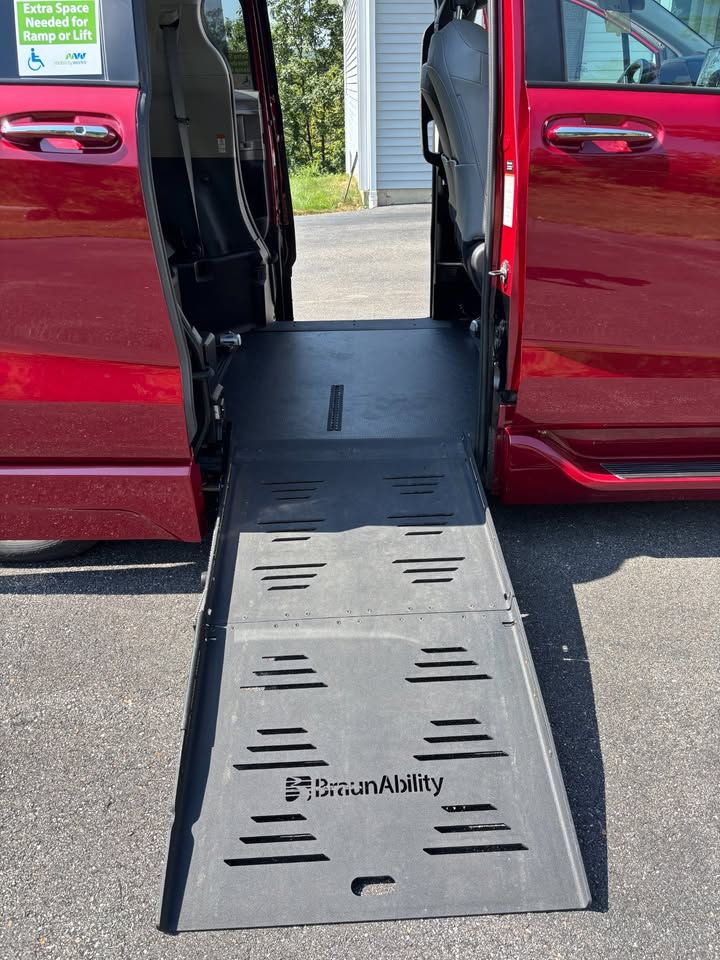
How to Safely Secure a Wheelchair in a Vehicle: The 4-Point Tie-Down and 3-Point Restraint Explained
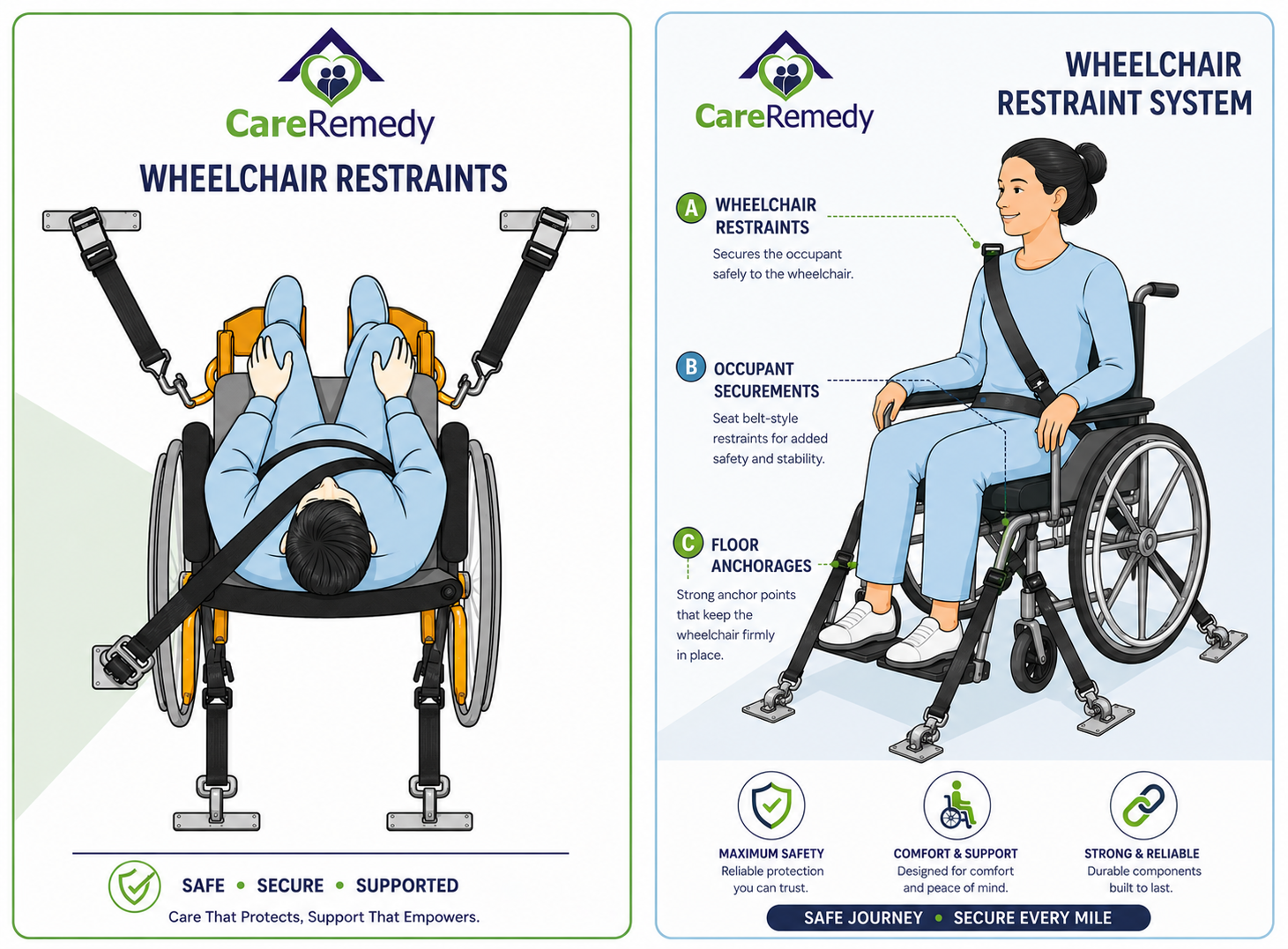
How to Safely Secure a Wheelchair in a Vehicle: The 4-Point Tie-Down and 3-Point Restraint Explained
Understanding the safety standards that protect wheelchair users during transport — and why getting them right is non-negotiable.
By Care Remedy · Serving Greater Boston, MA · Updated 2025
Every year, wheelchair users are injured in transport accidents that proper securement would have prevented. The cause is rarely a catastrophic collision. More often, it is a sudden brake, a sharp turn, or a modest impact — forces that an improperly secured wheelchair simply cannot withstand. Yet the solution is neither complicated nor expensive. It is a matter of knowing the correct system and applying it without exception.
The standard adopted across accessible transportation — from paratransit buses to medical transport vans — is the Wheelchair Tie-Down and Occupant Restraint System, universally known as WTORS. It consists of two distinct components, each addressing a separate but equally critical safety requirement: securing the wheelchair, and securing the person within it.
The Four-Point Tie-Down: Anchoring the Wheelchair
The first component is the four-point tie-down system. Four straps — two fastened to the front of the wheelchair frame and two to the rear — connect to anchor points on the vehicle floor, creating a stable, four-corner hold. When applied correctly, this system prevents the wheelchair from sliding, rotating, or tipping in any direction during the course of ordinary travel or in the event of a sudden stop.
The distinction between "correctly applied" and "incorrectly applied" deserves emphasis. Straps must be attached to the rigid structural frame of the wheelchair — never to wheels, armrests, or any removable component. Those parts are not designed to bear crash-load forces. Equally important, all four straps must be engaged. The temptation to use only two — a shortcut that saves perhaps thirty seconds — reduces the structural integrity of the securement dramatically and, in many jurisdictions, constitutes a regulatory violation.
The straps themselves should be firm and taut, but not overtightened to the point of stressing the wheelchair frame. Equipment should be inspected before every journey. Worn, frayed, or corroded hardware must be replaced immediately — these are not components where compromise is acceptable.
The Three-Point Occupant Restraint: Protecting the Person
Securing the wheelchair addresses only half of the safety equation. The person seated in it remains vulnerable unless they, too, are independently restrained. This is the purpose of the three-point occupant restraint system — functionally equivalent to the seatbelt found in any modern passenger vehicle.
The system comprises a lap belt, positioned low across the hips rather than the abdomen, and a shoulder belt running diagonally across the chest, both anchored to the vehicle structure. In a collision or emergency stop, these two belts work in concert to prevent the occupant from pitching forward or being ejected from the wheelchair entirely.
The positioning of the lap belt warrants particular attention. A belt that has ridden up to the soft tissue of the abdomen rather than sitting across the bony pelvis can cause severe internal injuries in a crash — injuries that would not have occurred with correct placement. Drivers and caregivers should verify the position of both belts before departure, not assume that they remain correctly positioned from a previous journey.
A Framework for Clarity
The relationship between the two systems is simple and worth committing to memory:
Four points secure the wheelchair. Three points secure the person.
Both must be used on every journey, without exception. A wheelchair anchored to the floor but without an occupant restraint leaves the individual at serious risk. An occupant wearing a restraint in an unsecured wheelchair faces the hazard of the entire chair — with them in it — becoming a projectile. Neither scenario is acceptable. Neither is safe.
Where These Standards Apply
WTORS requirements are not limited to specialised medical transport. They govern a broad range of accessible vehicles, including non-emergency medical transportation fleets, paratransit services operating under the Americans with Disabilities Act, school buses carrying students with disabilities, and privately operated accessible vans used by families and care organisations.
The underlying standards are set by the Rehabilitation Engineering Society of North America and the Society of Automotive Engineers, and are reflected in federal and state transportation regulations. Compliance is not merely best practice — in professional and commercial contexts, it is a legal obligation.
The Standard of Care Families and Commissioners Should Demand
For those selecting a transport provider on behalf of a wheelchair user, the question of securement practice is not a peripheral consideration. It belongs at the centre of any assessment. Prospective providers should be asked directly whether their vehicles are equipped with four-point tie-down systems, whether a three-point occupant restraint is provided as standard, whether drivers receive formal training in securement procedures, and how frequently equipment is inspected and certified.
A provider that cannot answer these questions with confidence and specificity is a provider whose services should be approached with considerable caution.
Conclusion
The science and engineering of wheelchair transport safety have long provided clear answers. The four-point tie-down and three-point occupant restraint system, properly applied, offers wheelchair users a standard of protection comparable to that afforded to any other vehicle occupant. What remains is the matter of implementation — ensuring that every driver, every caregiver, and every transport operator understands the system, respects its requirements, and applies it consistently.
Safe transport is not an aspiration. It is a standard. And for wheelchair users, it begins with getting these two systems right.
For guidance on accessible and safe transportation services for wheelchair users, contact our team. We are here to help you navigate the options with confidence.
Book Wheelchair Transportation in Massachusetts
Care Remedy provides safe, professional wheelchair transport across Massachusetts. Call us directly or send a message — we respond within 24 hours.
📞 Call (781) 957-8076Share