How to Safely Move Someone Up and Down Stairs at Home
Most families try to do it themselves first. Here's why that goes wrong, and what a trained two-person stair transfer actually looks like.
The call usually comes on a Tuesday afternoon. Mom is being discharged from rehab on Thursday. Her bedroom is on the second floor. She can't manage stairs anymore, and nobody in the family knows what happens next.
Sometimes it's a hospital bed that has to get to the second floor. Sometimes it's a broken elevator in a three-decker. Sometimes it's five granite steps between the front door and the sidewalk, and those five steps are the only reason someone hasn't left the house in two months.
Stairs are one of the most common reasons people end up stuck at home, and one of the least talked about.
Why "we'll just carry her" doesn't work
Almost every family tries this first. Two adult children, one on each side, or a spouse taking the weight from behind. It works once. Then it stops working.
The problem is physics, not willpower. On a staircase, the person carrying is off-balance by definition. Their center of gravity is behind them, they can't see their feet, and the weight they're holding is unpredictable, because a person is not a box. A leg spasms. A hand grabs the railing. Someone panics halfway down.
Three things tend to happen:
- The caregiver gets hurt. Back injuries from manual transfers are one of the most common injuries in caregiving, professional and family alike. A pulled back doesn't just hurt, it takes the primary caregiver out of commission.
- The person being moved gets hurt. A fall on stairs is a different category of fall. For an older adult, a hip fracture on a staircase can change the entire trajectory of their independence.
- It quietly stops happening. This is the most common outcome. It's not one dramatic event, it's the family deciding it's too risky, and the person upstairs slowly stops going to appointments, church, holidays, anywhere.
A staircase shouldn't be the thing that decides whether someone gets to leave their house.
What a safe stair transfer actually looks like
A proper transfer has four parts, and skipping any of them is where things go wrong.
1. The right equipment
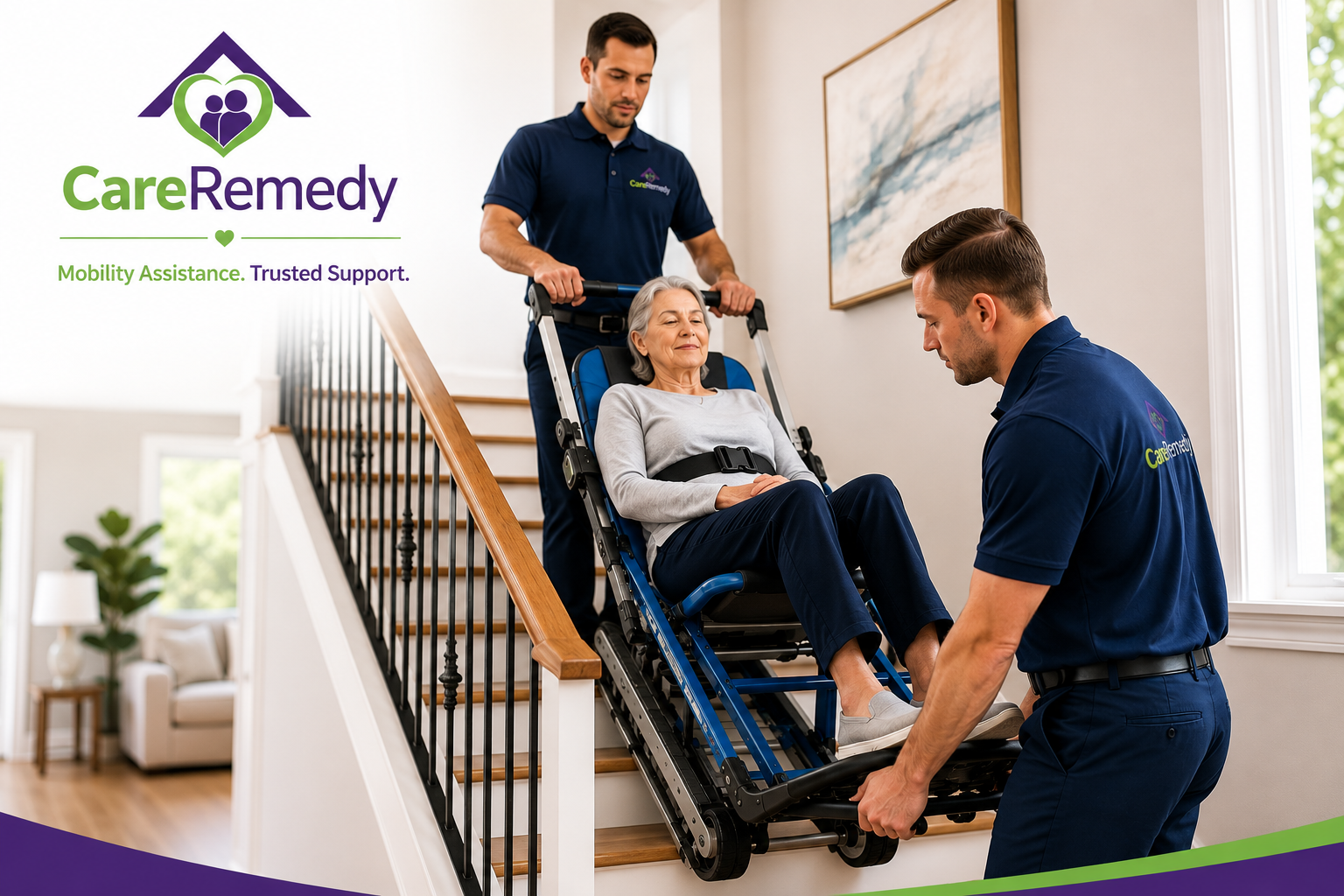
A track stair chair, sometimes called a stair climber or evacuation chair, uses a continuous rubber track that grips each stair edge and carries the load down step by step. The operator is guiding and braking, not lifting. That's the whole point. There are also powered climbers that do the work mechanically, which matter more as weight goes up.
2. Two trained people, not one
One attendant controls the chair from above, managing speed and angle. The second is positioned below as a spotter, stabilizing the chair, keeping the path clear, and watching the person's feet and legs. Two people is a minimum, not a luxury.
3. Securing the person properly
Chest and lap straps go on before the chair ever tips back. Feet are placed and stay placed. Arms stay inside the frame. Anyone who has ever grabbed a railing mid-descent understands why this matters.
4. Clearing and reading the staircase
Before anything moves: rugs up, shoes and laundry baskets out of the way, pets closed in another room, lights on. Narrow turns, landings, and open risers all change the approach. A good team walks the stairs before they use them.
When families call us
The situations repeat, and none of them are unusual:
- Hospital or rehab discharge to a home where the bedroom or bathroom is upstairs
- Medical appointments — dialysis, infusion, oncology, a specialist across town — where the barrier isn't the ride, it's the front steps
- Apartment and condo buildings with a failed elevator, or no elevator at all
- Post-surgical recovery, where the limitation is temporary but real for six to eight weeks
- Family events — a wedding, a funeral, a grandchild's birthday in a house with a split entry
- Moving day, when someone needs to get out of a home safely one last time
How to choose a provider
Not every agency that says it does mobility assistance is equipped for stairs. Before you book, ask:
- Do you send two trained attendants for every stair transfer, or one?
- What equipment do you use, and what's its rated weight capacity?
- Are your staff trained and documented on that specific chair?
- Are you insured for this service specifically?
- Will someone assess the staircase before the appointment, or do you show up blind?
- Can you also handle the transportation, so the trip isn't split between two vendors?
That last one matters more than people expect. If one company gets your father down the steps and a separate van company handles the ride, you're coordinating two schedules and two liability policies for one appointment. When the same team does both, there's one call and one point of accountability.
How Care Remedy handles it
We provide stair assist as a standalone service and as part of wheelchair-accessible transportation across Greater Boston, with offices in Woburn, Springfield, and Brockton.
A typical visit: we confirm the address, the number and type of steps, and the person's approximate weight and mobility level ahead of time. Two uniformed staff arrive with the chair. They walk the staircase, clear the path, explain to the client exactly what's about to happen, secure the straps, and make the descent slowly. If transportation is part of the booking, the vehicle is already at the curb.
Most families tell us the same thing afterward: it took less time than they expected, and it was much less dramatic than the version they'd been dreading.
Stairs shouldn't keep someone home
If you're facing a discharge date, a standing appointment, or a family event and the stairs are the obstacle, call us. We'll tell you honestly whether it's something we can help with.
Share