How to Get Someone Up Stairs Without a Stairlift
The call usually comes on a Tuesday. Someone is being discharged Thursday. The bedroom is on the second floor, or the front door sits at the top of a stoop, and the family has spent the morning getting stairlift quotes. Then they hear the number, and then they hear the timeline, and the room goes quiet.
Here are the numbers, from Massachusetts installers, not from us. A straight stairlift runs roughly $4,500 to $6,000 installed and can go in inside a single afternoon. A curved stairlift, which is what most older Massachusetts staircases need because they turn, starts around $15,500 and the custom rail has to be manufactured before anyone can install it. That build takes eight to ten weeks.
Eight to ten weeks is a long time when discharge is in two days.
And it is worth knowing before you start calling: Medicare's list of covered durable medical equipment is canes, walkers, wheelchairs, hospital beds, oxygen equipment and similar items. A stairlift is not on that list. Confirm with your own plan, but plan on paying for it yourself.
None of that means a stairlift is a bad idea. For a permanent situation in a home someone owns, it is often the right answer. It just does not solve the problem in front of you this week. This page is about what does.
The three ways a person actually gets up a flight of stairs
Strip away the equipment catalogs and there are three. Which one applies to you depends almost entirely on how much weight the person can put through their own legs.
One. Assisted walking with a gait belt
If the person can bear weight and take a step, two trained people can bring them up a staircase one tread at a time using a gait belt, with one aide below and one above or beside them depending on the width of the run. The belt goes around the waist and gives the aide something solid to hold that is not a shoulder, an elbow or a waistband. This is slow. A first flight after hip surgery can take four or five minutes. Slow is fine. Slow is the point.
The rule taught in every rehab gym in Massachusetts is up with the good leg, down with the bad. Going up, the stronger leg leads and lifts the body. Coming down, the weaker leg goes first onto the lower tread while the stronger leg is still braced above and taking the load. Families reverse this constantly, which is how people fall on the way down.
Two. A stair chair
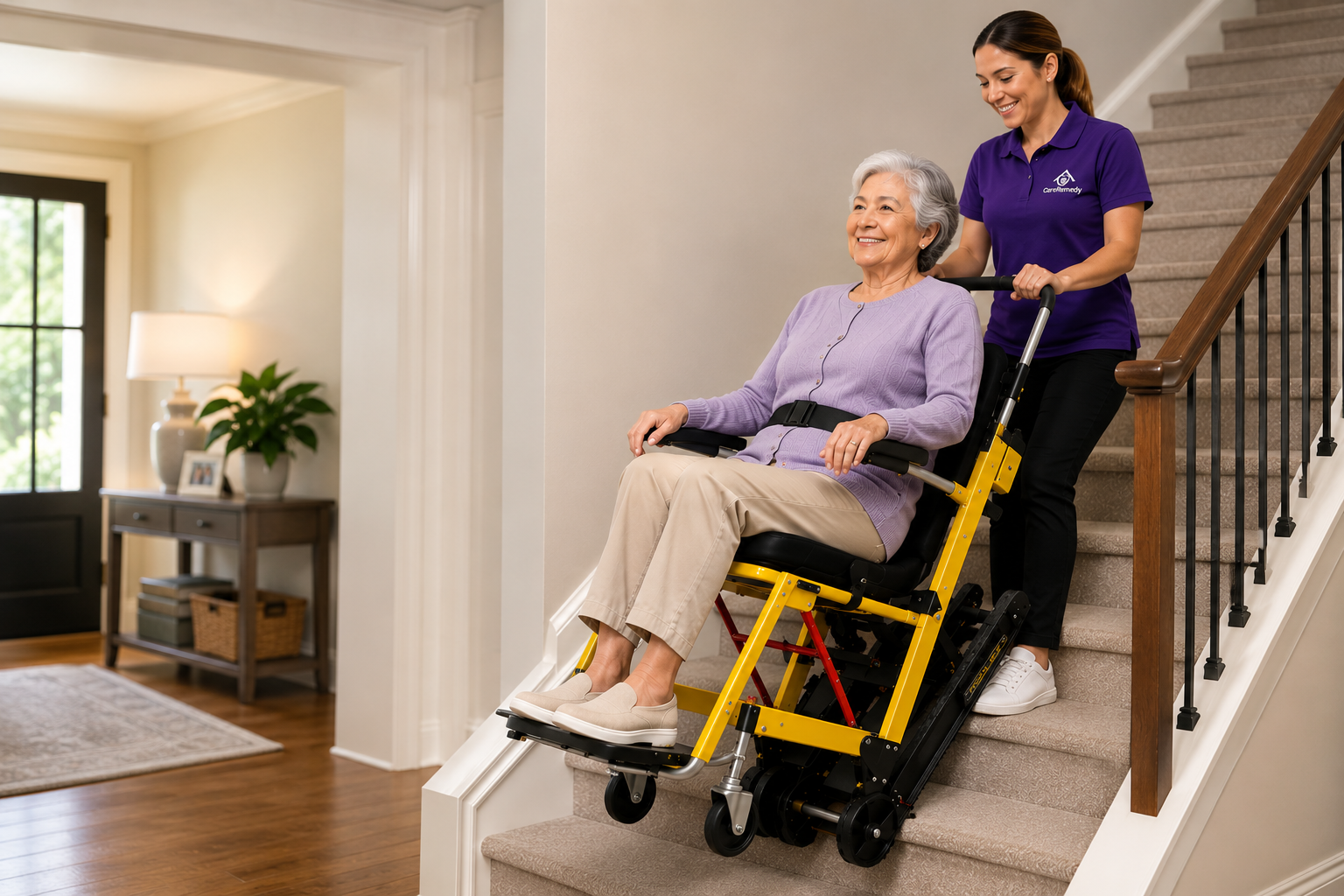
When a person cannot bear weight at all, the answer is the chair the fire department uses. A stair chair is a narrow folding chair with a track or a set of glides on the back. The person is seated, strapped at the chest and knees, and the chair is tipped back and walked down the treads by trained operators, one steering from behind and one controlling the descent from the front. Going up is the same in reverse.
This is the piece most families do not know exists outside of an ambulance. It is not a lifting device and it is not a hoist. It is a way of moving a seated person down a staircase under control, and it works in stairwells far too narrow for anything on wheels. It is also the reason we ask about the turn at the bottom of your stairs before we ever quote a job.
Three. A wheelchair over a small number of steps
One step at a threshold. Three steps off a porch. Four up from the sidewalk. These are not staircases and they do not need a staircase solution. Two trained people can back a wheelchair up a short run of steps, one at the handles tipping and pulling, one at the frame taking weight from below. Nobody lifts by the armrests, the footplates or the wheels, all of which detach or fold on most chairs, which is exactly how family members get hurt trying this alone.
If your entry is four steps or fewer and there is room beside them, a portable ramp is worth asking about instead. Ramps need roughly one foot of run for every inch of rise to be safe, so four seven inch steps means about twenty eight feet of ramp. That fits in almost no Massachusetts front yard, which is why so many families end up back at the stair chair.
Massachusetts staircases, by what your house actually is
We work across eastern and central Massachusetts and the honest truth is that we plan the job by building type, not by town. A triple decker in Somerville and a triple decker in Worcester present the same problem. A Victorian in Newton and a Victorian in Springfield's McKnight district present the same problem. Here is what we look for in each.
The triple decker
Dorchester, Somerville, Cambridge, Quincy, Medford, Malden, Everett, Chelsea, Revere, Brockton, Worcester, Lowell, Lawrence, Fall River and New Bedford are full of them, and they almost always have two staircases. There is the front stair, wider, carpeted or once carpeted, with a landing and a turn at each floor. And there is the back stair off the kitchen, which is steeper, narrower, often unheated, and frequently the one that actually reaches the door people use.
Families default to the back stairs because that is the door they always use. We almost always use the front. The extra width and the landing partway up are worth the walk around the building, and the landing gives everyone a place to rest that a straight back run does not.
The brownstone and the walk up
Back Bay, the South End, Beacon Hill, Charlestown and parts of Brookline share one feature that catches everyone out: the stoop happens before the building does. You climb six to twelve exterior steps just to reach the front door, then the interior flights start. On a rainy or icy day that stoop is the most dangerous part of the entire trip, and it is the part nobody plans for. We plan for it. We also ask whether the vestibule has a second door, because two doors in a row with a landing between them can be tighter than the stairs themselves.
The Victorian with a turning staircase
Newton, Brookline, Melrose, Arlington, Winchester, Milton and the McKnight and Forest Park neighborhoods of Springfield are full of staircases that turn ninety degrees on wedge shaped treads. Those wedge treads are the reason a curved stairlift costs three times a straight one, and they are also the reason the turn has to be measured before anyone commits to a plan. A stair chair handles a turn well. A person walking with two aides handles it badly, because there is a point on a wedge tread where three people cannot all stand safely.
The mill conversion and the elevator that does not go everywhere
Lowell, Lawrence, Haverhill, Ludlow and the Canal District in Worcester have beautiful mill buildings with long single runs and, often, an elevator. Ask two questions before you relax about the elevator. Does it reach your floor, or does it stop one short of the loft level? And is there a step or a raised threshold between the elevator lobby and your unit? A single unexpected step at the end of an accessible route is one of the most common calls we get.
The raised ranch and the split level
Across the suburbs, from Woburn and Wilmington out through Framingham, Marlborough and Shrewsbury, the split level puts a half flight between the front door and every room in the house. There is no ground floor to retreat to. You cannot set up a hospital bed in the living room and avoid the stairs, because the living room is up half a flight too. These homes need a plan for every single trip, including the trip to the car for a follow up appointment, and that is usually a scheduled standing arrangement rather than a one off.
The raised entry near the water
In Quincy, Revere, Winthrop, Hull, Scituate and along the South Shore, plenty of homes sit up on a raised foundation for flood reasons, which means eight or ten exterior steps and a landing before you are inside. Add a Nor'easter and those steps are the whole job. We bring the person, and we also bring the sense to salt the treads first.
Four measurements that decide everything
Whether you call us or anyone else, have these ready. A tape measure and four minutes will save you a wasted visit.
- Width of the narrowest point. Measure between the walls, or between the wall and the handrail if the rail sticks out. Not the width of the treads. The narrowest point is what matters, and it is usually at a doorway or a turn.
- Number of steps in each run. Count them per flight, not in total, and say where the landings fall.
- The turn. Is it straight, does it turn ninety degrees at a square landing, or does it wind around on wedge shaped treads? These three are completely different jobs.
- What is at the bottom. A wall three feet from the last step changes the plan more than anything on the staircase itself, because the chair and the people have to finish the movement somewhere.
A photo from the bottom looking up, and a second from the top looking down, tells us more than a paragraph of description. Text them to us before the discharge date and we will tell you honestly whether we can do it.
What this costs compared to a lift
We bill hourly. That makes the comparison genuinely different, not just cheaper or more expensive, and it is worth thinking about honestly before you decide.
A stairlift is a large one time cost that then costs nothing per trip, and it only makes sense in a home the person owns or has a long lease on, for a situation expected to last years. If that describes you, buy the lift. We will happily tell you so on the phone.
Hourly stair assistance makes sense in three situations a lift cannot cover. When the need is temporary, which describes most orthopedic recovery. When the person rents, and no landlord in Somerville is letting you bolt a rail to a shared staircase. And when the need is right now, because a rail that ships in ten weeks does not help with a Thursday discharge. Plenty of families use us for the ten weeks and then use the lift for the ten years.
What we will not do
We will tell you no if the staircase is genuinely unsafe. Some are. An open riser stair with no handrail, a run under twenty six inches wide with a person who cannot be seated upright, an outdoor stair under ice with no way to clear it. In those cases the answer is a different door, a different room, or in a small number of cases an ambulance crew, and we would rather say that on the phone than discover it in your hallway.
We are also not a medical transport service and we do not provide emergency response. If someone has fallen and cannot get up, call 911. Fire departments across Massachusetts perform lift assists as a matter of routine and there is no charge and no shame in it.
Questions we get every week
Can one person do this alone?
For a stair chair, no. Two trained operators, always. For a gait belt assist with someone who can bear weight, one aide is sometimes appropriate on a straight run with a solid rail, and we will tell you which after we see the photos. The most common injury in this whole category is a family member trying it alone on the way down.
Can you come more than once?
Yes, and most people need that. A single trip home from the hospital is the smallest version of this. The bigger version is the standing arrangement: down on Tuesday mornings for physical therapy, back up after, down again Friday for the surgeon. We schedule those in advance so the same aides who learned your staircase are the ones who come back.
Does MassHealth pay for this?
Stair assistance on its own is generally private pay. If you have MassHealth Standard or CommonHealth and a permanent or chronic disability, the Personal Care Attendant program may cover ongoing help with daily activities, and MassHealth's PT-1 program can cover rides to medical appointments. Neither is instant and neither covers a Thursday discharge, but both are worth starting. Call MassHealth at (800) 841-2900 and ask about both.
What if we are on the fourth floor?
Tell us before we come. Four floors is not a harder version of one floor, it is a different job with rest points and a different crew plan. We have done it. We have also arrived at a stated second floor that turned out to be a fourth floor walk up, and that is a bad afternoon for everybody.
Call before the discharge date, not after
The single most useful thing you can do is call us the day you learn the discharge date rather than the morning of. It costs you nothing to ask, it lets us look at your photos and tell you honestly whether the staircase is workable, and it means the aides who show up already know what they are walking into.
Care Remedy provides stair assistance and wheelchair transportation across eastern and central Massachusetts from offices in Woburn, Springfield and Brockton. Call 781-957-8076 and describe your staircase.
Stairlift pricing and manufacturing lead times cited above reflect Massachusetts installer figures published for 2026 and will vary by home and by vendor. Medicare and MassHealth coverage rules change. Confirm current details with your plan before making a decision.
Share