How to Get a Wheelchair Up Steps at the Front Door
A family plans the whole thing carefully. The hospital bed is ordered. The bathroom has grab bars. The wheelchair arrived Tuesday. Then the van pulls up on Thursday afternoon and everyone is standing on the sidewalk looking at four granite steps that have been there since 1908 and that nobody thought about once.
This is the most common single failure point in getting someone home in Massachusetts, and it is not a staircase problem. Four steps is a completely different job from a flight of stairs, with different physics and a different answer. Here is how it actually gets done.
First, know which chair you have
Everything below assumes a manual wheelchair, which typically weighs somewhere between thirty and fifty pounds empty. A transport chair, the lighter one with four small wheels and no hand rims, is lighter still.
A power wheelchair is a different universe. Depending on the model and the battery, a power chair can weigh two hundred and fifty to four hundred pounds on its own, before anyone sits in it. You do not carry a power chair up steps. Nobody carries a power chair up steps. If the person uses a power chair and the entry has steps, the answer is a ramp, a vertical platform lift, a different entrance, or the person transferring to a manual chair at the curb while the power chair goes in some other way. Please do not let anyone talk you into improvising with a power chair on a stoop. That is how people get crushed.
One step or a curb
A single step is handled with a tip back, and the whole technique lives in the small wheels at the front. Those front casters are the problem. They are four to eight inches across and they stop dead against anything taller than about an inch and a half. The large rear wheels will roll over far more than the casters will, so the technique is simply about getting the casters off the ground and letting the rear wheels do the work.
Going up a single step, the helper stands behind the chair, tells the person what is about to happen, steps on the tipping lever at the back with one foot while pulling gently back on the handles, brings the casters up over the lip, rolls the chair forward until the rear wheels touch the riser, then lifts and pushes the rear wheels up onto the step. Going down, the same in reverse and facing backwards: the helper goes down the step first, backwards, lowering the rear wheels under control, then sets the casters down last.
Two things people get wrong. They tip too little, so the casters catch halfway and the chair stops hard, which throws the person forward. And they go down a curb facing forwards, which drops the casters into the gutter first and pitches the person out of the chair. Down is always backwards.
Say what you are doing before you do it, every time. Being tipped backwards without warning is genuinely frightening, and a person who grabs at a doorframe mid tip makes the whole thing worse.
Two to four steps
Now it takes two people, and the honest answer is that it takes two people whether or not one strong person believes otherwise. The chair is tipped back onto its rear wheels and the person behind pulls it up one riser at a time, with the rear wheels rolling up each step, while the second person faces the chair from below with hands on the solid frame near the front, taking weight and controlling the tip angle rather than lifting.
One riser at a time, pausing between each. Never two at once for momentum. Momentum is what you have instead of control.
The three places you never hold
This is the part that sends family members to the emergency room, and it is entirely avoidable. On most modern wheelchairs, three parts are designed to come off.
- The armrests. On most chairs they are removable by design, so the person can transfer sideways to a bed or a car seat. Lift by an armrest and it can come away in your hand with the whole weight of the chair behind it.
- The footplates and leg rests. These swing away and detach, again by design. They are also right where a helper standing below instinctively puts their hands. They are the single worst place to grip.
- The wheels. Many chairs have quick release rear wheels that come off with a button in the hub so the chair fits in a trunk. Grabbing a spinning wheel is bad enough. Grabbing one that detaches is worse.
Hold the solid welded frame only, and find it with your hands before you start rather than in the middle of the movement. If you cannot find a solid part of the frame low on the chair, that chair should not be carried by that route.
Five steps or more, or a granite stoop
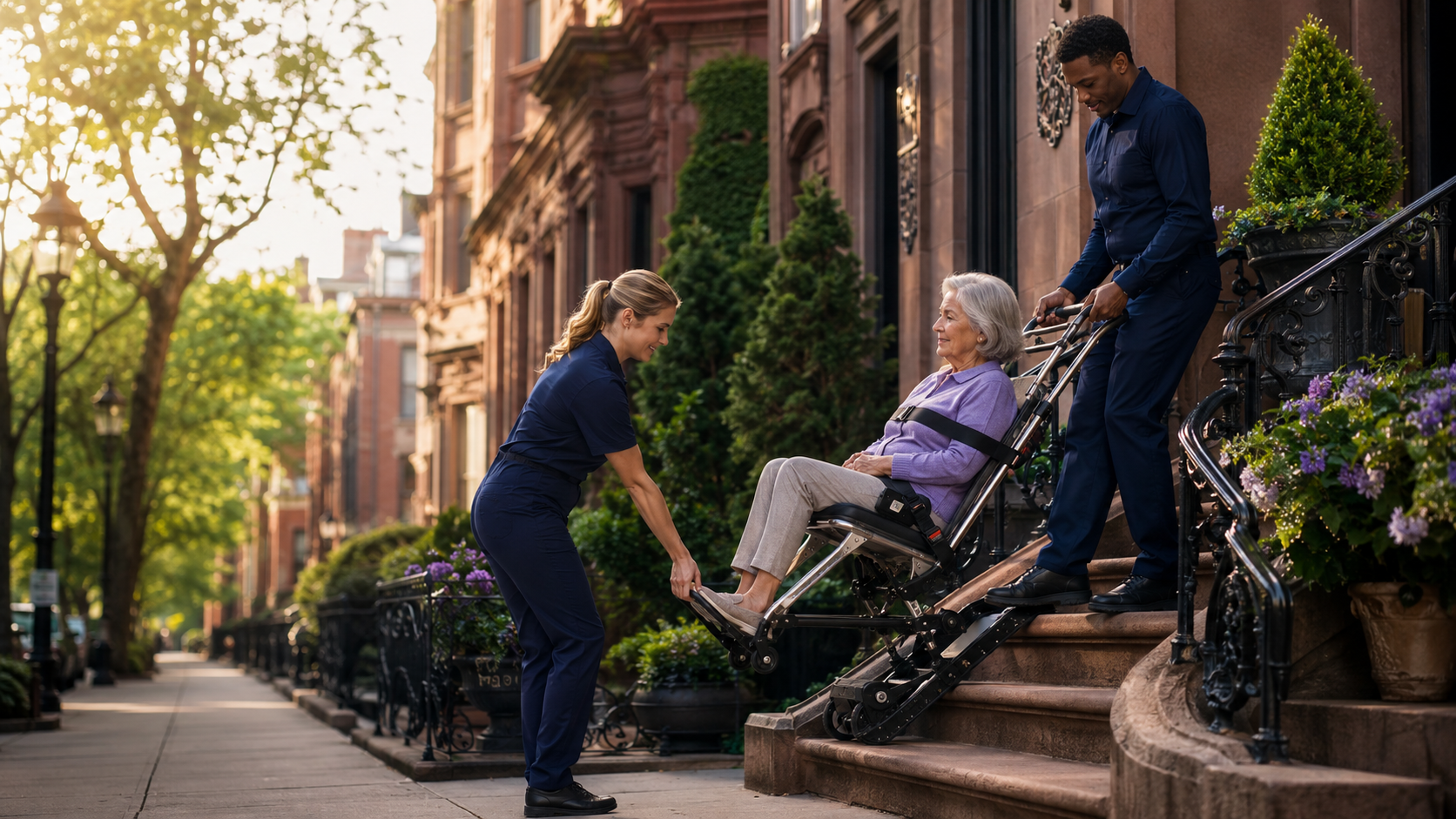
Past four steps the calculation changes. The helpers are now carrying combined weight up a run long enough that someone's grip or back gives out partway, and there is no landing to set down on. This is where the answer stops being a wheelchair technique and becomes a stair chair: the person transfers into a narrow seated chair with straps, two trained operators walk them up the treads, and the wheelchair is carried up separately and empty.
Massachusetts stoops make this common. A Back Bay or South End brownstone typically has six to twelve exterior steps before the front door. Homes raised for flood clearance in Quincy, Revere, Winthrop, Hull and along the South Shore often have eight or ten. Older triple deckers in Dorchester, Somerville, Worcester, Lowell and Brockton usually have four or five to the porch, which is right on the boundary, and the porch step is frequently a different height from the ones below it, which is exactly where people trip.
Granite deserves its own warning. A lot of nineteenth century Massachusetts steps are granite slabs that have worn into a slight dish in the middle over a hundred and twenty winters. That dish holds water, and water freezes. A granite stoop in January is more slippery than it looks and less even than it looks. Salt it the night before and check it in daylight.
Why you probably cannot fit a ramp
Everyone's first instinct is a ramp, and it is a good instinct that runs into arithmetic. The federal accessibility standard sets the maximum running slope for a ramp at 1:12. That means one foot of ramp for every inch of vertical rise.
Do the arithmetic on your own front steps. Four steps at a typical seven inch riser is twenty eight inches of rise, which needs twenty eight feet of ramp. A Back Bay stoop with ten steps is roughly seventy inches, which needs about seventy feet, and the same standard caps any single ramp run at thirty inches of rise before a landing is required, so that becomes multiple runs with a five foot landing between them. The standard also calls for at least thirty six inches of clear width, five foot landings at the top and bottom, and handrails on any run rising more than six inches.
Twenty eight feet of ramp does not fit in a Somerville front yard. Seventy feet does not fit anywhere in Back Bay. This is not a failure of imagination on anyone's part, it is a real geometric constraint, and it is why the great majority of Massachusetts homes with steps end up needing people rather than a ramp.
Where ramps genuinely do work: a single threshold, where a small rubber or aluminum threshold ramp solves the whole problem for well under a hundred dollars and should be the first thing you buy. A one or two step back entrance with a wide side yard. A raised ranch in the suburbs where there is actually lawn to run a switchback across. If your home is one of those, get quotes, because a permanent ramp beats calling anyone forever. If it is not, stop measuring and start planning for people.
The other door
Before you accept the front steps as fixed, walk the whole property once. In an enormous number of Massachusetts homes there is a better door that nobody uses.
A back door off a driveway that sits one step up instead of five. A bulkhead or basement entry at grade with an interior stair that is easier than the exterior one. A garage that is level with the house, which is the standard arrangement in raised ranches from Woburn out through MetroWest and is regularly overlooked because the garage is full. A side door on the driveway side of a triple decker. A rear porch reached from a paved yard rather than the sidewalk.
Two steps instead of six, or a level garage instead of a stoop, changes this from a job that needs a crew into a job one person can do. It is fifteen minutes of walking around the outside of the house and it is the highest value fifteen minutes in this entire article.
Questions we get
Can the medical transport driver help with the steps?
Ask, and ask specifically, because the answer varies a great deal and the assumption catches people out. Many transport services take the person from the vehicle to the door and no further. Some go to the threshold. Some will not go up steps at all, which is a reasonable policy on their part given what they are insured for. Find out before the day, in a phone call, in plain words: will your driver bring my mother up four granite steps and through the front door, yes or no. If the answer is no, that gap is what we fill.
Can I just do it myself if I am careful?
One step or a curb, with a manual chair, with warning given, yes, and most families learn this in a week and never think about it again. Two to four steps, no, not alone, regardless of how strong you are, because the failure is not gradual. Five or more, no. We are not being precious about this. The reason we say it plainly is that we have arrived at homes where the fall already happened and the person we were called to help is now waiting on an orthopedic floor themselves.
What about the ones that climb stairs by themselves?
Powered stair climbing wheelchairs and track based stair climbing attachments exist and they work. They are expensive, they are heavy, they need an operator who has been trained on that specific device, and they have real limits on tread depth and stair width that a lot of older Massachusetts staircases fail. They are worth investigating for a permanent situation. They are not the answer for getting home on Thursday.
Do I need to own a wheelchair before you come?
No. Tell us what you have and what you do not have when you call. It changes the plan and it changes what we bring.
Send us a photo of the steps
One photo from the sidewalk, standing back far enough to see the whole entry including the door and any railing, tells us almost everything. Count of steps, presence of a rail, width of the path, whether there is a landing at the top, what the surface is. Text it over and we will tell you what the job is and whether you need us at all, which some of the time you do not.
Care Remedy provides stair assistance and wheelchair transportation across eastern and central Massachusetts from offices in Woburn, Springfield and Brockton. Call 781-957-8076.
Ramp dimensions above are drawn from the 2010 ADA Standards for Accessible Design, Section 405. Those standards govern public accommodations rather than private homes, so a home ramp is not legally bound by them, but the slope and landing figures reflect what is actually safe to push a wheelchair up and are the right basis for planning. Wheelchair weights vary by model. This is general information and not medical advice.
Share