How to Get Someone Up and Down Stairs in a Boston Brownstone or Walk-Up
Someone comes home from hospital and cannot manage the stairs. Maybe it is after knee surgery, maybe a broken leg, maybe a parent whose balance has quietly gone over the past year. The bedroom is on the second floor, or the front door is eight granite steps above the sidewalk, and suddenly the building itself is the problem.
Most advice assumes you can install a stairlift or build a ramp. In much of Boston you cannot, or not quickly, and this guide is about what to do in that situation.
First: why you may not be allowed to install anything
Boston has eleven local historic districts with commissions under the Boston Landmarks Commission. They include the Back Bay Architectural District, the Historic Beacon Hill District, the South End Landmark District, Bay Village, the St. Botolph Area, Bay State Road and Back Bay West, Mission Hill Triangle, Highland Park, Aberdeen in Brighton, Fort Point Channel, and Monument Square in Charlestown.
If your building is in one, exterior changes go through design review first. A ramp is an exterior change. So is an outdoor lift, a new railing, a modified entry, or a replacement door. That does not make the work impossible, but it means an application, a hearing, a timeline, and an outcome nobody can promise you.
Families find this out at the worst moment, about a week after someone comes home unable to climb the front steps.
Find out now instead. Call the Landmarks Commission on 617-635-1935 or email BLC@boston.gov and ask whether your address is in a district. It is free and takes minutes.
In a condominium there is a second layer. The facade and the shared stairwell usually belong to the association rather than to you, so the trustees have a say whatever the city decides.
Getting someone up and down stairs without a stairlift
This is where most Boston families end up, either because installation is not permitted, or because the staircase turns and a curved rail costs several times a straight one and takes weeks to build, or because the person only needs help for a few weeks of recovery and buying equipment makes no sense.
There are three honest answers.
Move daily life to one floor
A bed in the front room and a commode is not what anyone pictures, but it works during recovery and costs nothing. It does not solve getting out of the building for appointments, which is usually the next problem.
Two family members lifting
This is what most people try, and it is where the second injury happens. On a turning staircase, carrying an adult who cannot bear weight, the person most likely to get hurt is the one doing the helping. Backs and shoulders, usually. If you are going to do it anyway, do it with two people, go down rather than up when you have the choice, and never carry someone alone.
A stair chair worked by trained staff
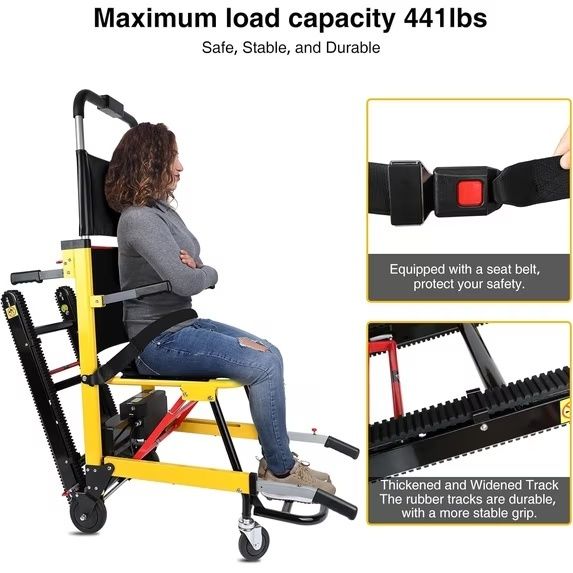
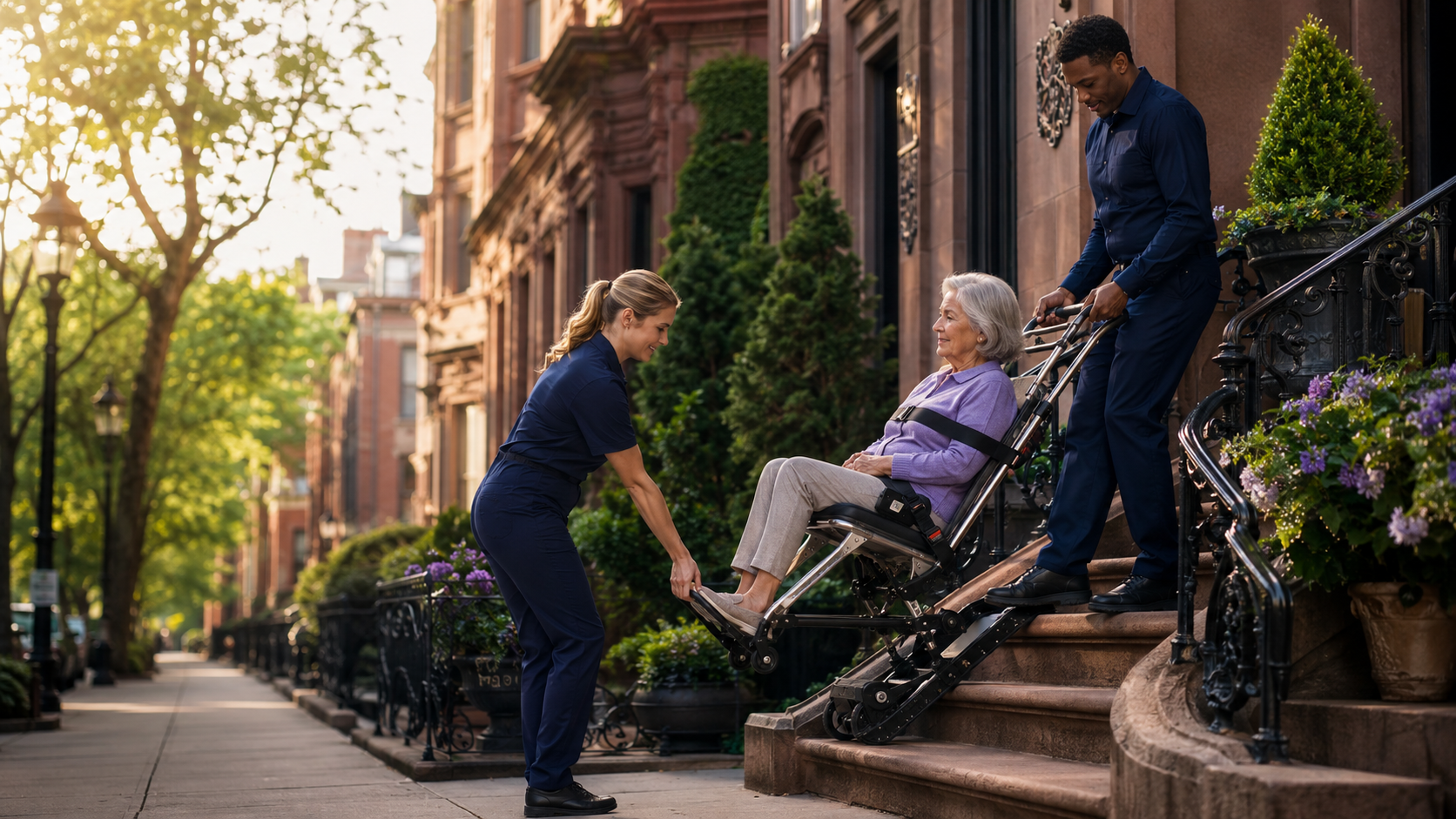
A stair chair is real equipment, the same category fire and EMS crews carry. The person sits, is secured with chest and leg straps, and the chair takes the weight on each step while two trained people control the descent. Track models roll down a flight rather than being lifted step by step.
It requires no modification to the building at all, which is exactly why it works in neighborhoods where modification is not on the table.
A word about calling 911
If someone has fallen or is in medical distress, call 911. That is what it is for, and do not hesitate.
But a scheduled trip to a cardiology appointment is not an emergency, and routine lift assist calls tie up a crew that may be needed elsewhere. Planned trips deserve a planned solution.
If the person uses a wheelchair
A wheelchair does not go down a staircase, and no amount of care makes tipping one down a flight safe. The person transfers to a stair chair for the stairs, then back into their own chair at the bottom.
If a vehicle is involved, the chair should go into it without a second transfer. Ramps or hydraulic lifts and four point securement mean the person stays seated in their own wheelchair for the whole journey, rather than being moved into a car seat on the pavement.
After surgery specifically
Knee and hip replacements now routinely send people home the same afternoon. That is better medicine, and it moves an entire category of care from a ward with lifts and nurses to a house with a staircase and one tired relative.
Two things families underestimate. Sedation wears off slower than people expect, so someone who managed the steps that morning genuinely cannot that evening. And going up is harder than coming down, which matters because the trip home from an appointment is the one where the person is most tired.
Plan the return before the trip starts, not when you are standing at the bottom of the steps.
What you are dealing with, by Boston neighborhood
Back Bay
The high stoop is deliberate. When these houses went up on filled land in the 1860s and 1870s the parlor floor was raised above the street, which leaves eight or ten granite steps before the front door. Inside, four and five storey buildings with staircases built narrow because the lots were narrow. Many are now condominiums, so a third floor resident climbs everything below. The stoop alone stops most wheelchairs.
Beacon Hill
Older and tighter. Sharper turns, lower ceilings, smaller landings. The historic brick sidewalks are uneven by design, which matters before you reach the door, and the hill adds a grade to every approach. Charles Street is level. Almost nothing above it is.
South End
Bowfront brownstones with high stoops, in a landmark district. Look at the garden level entrance below the stoop. Sometimes it is a genuine step free alternative, sometimes it has its own steps down. Worth checking rather than assuming either way.
North End
Nineteenth century walk-ups on streets laid out before cars. The tightest interior staircases in the city, and parking anything close to a door is its own problem. This is the neighborhood where a staircase most often needs looking at before anyone promises it can be worked.
Charlestown
Federal era houses around Monument Square, plus the hill. Short flights, steep approaches, and a landmark district under study for the square itself.
Fenway, Longwood and Kenmore
Pre-war apartment buildings, many with elevators. Count the steps between the lobby and the sidewalk before assuming you are covered. An elevator that starts half a flight above street level leaves you exactly as stuck as no elevator at all, and it is more common here than anywhere else in the city.
Dorchester, Roxbury, Jamaica Plain and South Boston
Triple deckers. An exterior flight to the porch, then one interior flight per floor, usually turning at a landing. A third floor unit means three full flights after the front steps.
When it will not work, and why we say so
A genuinely spiral staircase, a landing too small to turn on, or a door at the foot of the stairs that opens the wrong way can each make a flight unworkable no matter who is carrying the chair.
Anyone who tells you every staircase can be handled has not seen enough of them. We would rather look at yours and give you an honest answer than send a crew to improvise at your door.
Six things to check at your own building
1. Count the exterior steps from sidewalk to door, and note whether there is a handrail and which side it is on.
2. Count the interior flights and note where they turn.
3. Measure the narrowest point, usually a landing or the doorway at the bottom.
4. If there is an elevator, count the steps between it and the street. This is the one people get wrong.
5. Work out where a vehicle can legally stop, and for how long. Resident permit blocks in Back Bay and the South End are not a detail.
6. Call 617-635-1935 and ask whether your address sits in a historic district.
Those six answers tell any provider, us or anyone else, whether your building can be worked and how. They turn a vague phone call into a real plan.
How Care Remedy helps
We bring the equipment and two trained staff, and we settle the parking on the booking call rather than discovering it at the curb. If the trip continues to an appointment, our wheelchair accessible vehicles have ramps or lifts and four point securement.
We also provide the escort who waits through a procedure and receives the discharge instructions, and hourly care at home afterward with a registered nurse overseeing the plan. There is more detail on how this works step by step if you want it.
Care Remedy is BBB Accredited with an A+ rating and a Boston Magazine Top Senior Living Community for 2026.
Call 781-957-8076 with your six answers and we will tell you what is possible at your building.
District boundaries and review requirements change. Confirm your own address with the Boston Landmarks Commission rather than relying on this page.
Share