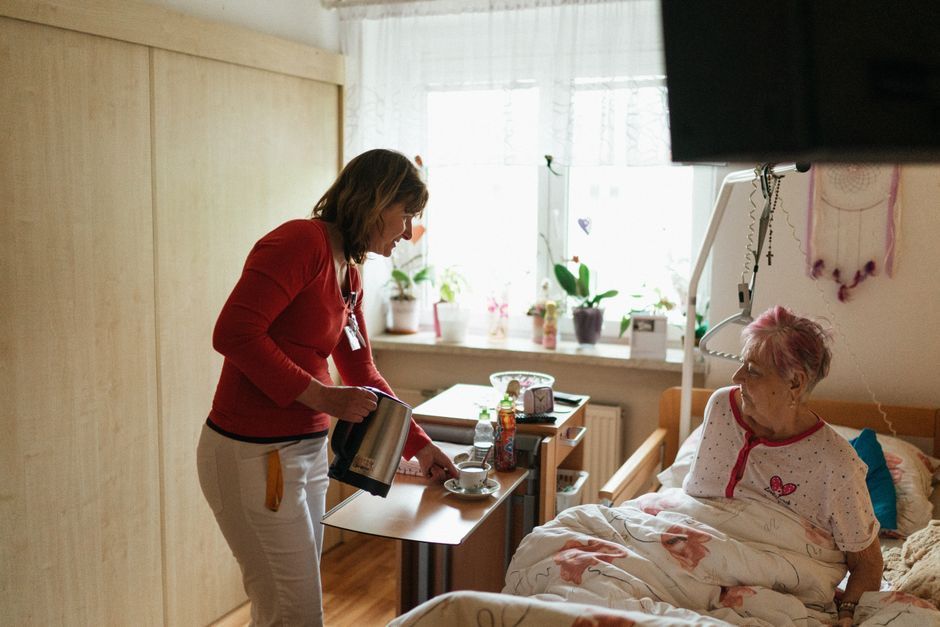
Parkinson's Home Care in Massachusetts: Costs, Freezing and Falls
Need help in Massachusetts? Care Remedy provides home health aides at $45 an hour, stair assistance at $200 a visit and wheelchair transportation from $115 each way. Call 781-957-8076 .
An aide cannot administer medication, and with Parkinson's that is the limitation to understand before you hire anybody. Our aides are trained, background checked and insured but they are not nurses. They can be present while a client takes their own doses, help if something goes wrong, and call for help. If the doses themselves cannot be managed independently, you need nursing, which is a separate service.
Everything else, an aide does well. Home health aide care is $45 an hour, one to eight hours a day, no minimum contract and no assessment fee.
Why does medication timing matter so much here?
Because Parkinson's medication works on a schedule rather than a dose. A dose taken an hour late can mean an afternoon where somebody cannot get out of a chair, and a family that treats the pill bottle casually finds out why neurologists are strict about the clock.
What an aide contributes is reliability of presence. Somebody is in the house at 7, at 11, at 3 and at 7, which means the doses are not missed because a person who was alone forgot or could not reach the bottle. That is not the same as administering them, and we will not pretend otherwise.
What does the help actually look like day to day?
- Dressing, which is the task Parkinson's takes apart first. Buttons, zippers, socks and shoes stop being possible long before walking does.
- Bathing and grooming, on a wet floor, with a tremor, which is the highest risk activity in the house.
- Transfers and walking, especially the moment of standing up and the first two steps.
- Meals, cut up and manageable, and sat with. Eating gets slow and food gets cold, and people quietly stop eating enough.
- The exercises the physical therapist assigned, done on the days the therapist is not there, which is most days.
- Light housekeeping and laundry, which matters more than it sounds when somebody is spending their energy budget on getting dressed.
What about freezing?
Freezing is when the feet stop while the body keeps going, and it is why so many Parkinson's falls happen in doorways and turns. An experienced aide knows not to pull on the person's arm, which makes it worse, and knows the cueing that helps instead: counting out loud, marching in place, stepping over a line or a target on the floor.
Ask the physical therapist which cues work for your person specifically, write them down, and tell the aide. They are individual, and the one that works is often not the obvious one.
Will MassHealth PCA hours cover this?
For the physical help, often yes. For the cueing and supervision, no, and that is the most important funding fact for a Parkinson's family to understand. The PCA program pays for physical, hands on assistance and specifically excludes cueing, prompting and supervision.
So a person who needs hands on help dressing and transferring may well qualify. A person who is still physically capable but needs somebody present because of freezing, falls or medication timing is exactly the person the program does not fund, and that is why private hours exist. We go through the disqualifiers on what makes you ineligible for PCA hours, and the hour arithmetic on how MassHealth decides how many hours you get.
How many hours do people usually start with?
Three or four in the morning, because that is when dressing, bathing and breakfast all land in the same stretch and that stretch is the hardest part of a Parkinson's day. Four hours a day is $180, which comes to about $5,460 a month. Three hours twice a week, which is where a lot of families begin, is around $1,170 a month.
Parkinson's is a long road, so plan for a schedule you can sustain for years rather than one that empties the account in eighteen months. Full monthly figures are on the home care cost page.
Is the same aide every time, or whoever is available?
Ask this of any agency you call, and with Parkinson's weight the answer heavily. Somebody who knows this person's freezing cues, their timing, how they transfer and what their good hours look like is worth considerably more than somebody competent who has never met them. Continuity is not a nicety here, it is most of the value.
Also ask who covers when that person is sick, because a rotating cast of strangers is how a Parkinson's schedule falls apart.
What should we have in the house?
Ask the occupational therapist rather than a website, but the recurring items are grab bars at the toilet and the tub, a raised toilet seat, a shower chair, clear floor paths with no throw rugs, and lighting on the route to the bathroom. Most Parkinson's falls happen in the places you would predict, going to the bathroom at night and turning in a doorway.
If the house has stairs the person is starting to lose, the state's Home Modification Loan Program makes loans for ramps, bathroom changes and lifts. Worth looking at before the stairs become the reason somebody moves.
What free help should we ask about first?
Three. Your town's Council on Aging for rides to neurology and therapy appointments, which are frequent and recurring. Your local Aging Services Access Point, which runs an income based state home care program. And a Parkinson's support group, which costs nothing and is where families learn the practical tricks nobody writes down.
Care Remedy serves eastern and central Massachusetts from offices in Woburn, Brockton and Springfield. Call 781-957-8076 and tell us which parts of the day are hardest, and we will tell you where hours are worth buying and where they are not.
This is general information about care at home and not medical advice. Medication schedules, exercise programs, equipment and fall precautions should come from the treating neurologist and therapists.
Share