
Rett Syndrome in Massachusetts: Rides to Therapy and Help at Home
Need help in Massachusetts? Care Remedy provides home health aides at $45 an hour, stair assistance at $200 a visit and wheelchair transportation from $115 each way. Call 781-957-8076 .
If your child is under three, the therapies are free and the state runs them. Massachusetts Early Intervention covers birth to three with no out of pocket cost to the family, and it comes to your house. What it does not cover is the driving to specialty appointments, the extra hours of one on one supervision, and the evenings and weekends. That is the gap a private agency fills, and ours is $45 an hour with no minimum contract.
What does the week actually look like?
Full. Most families with a Rett syndrome diagnosis are running physical therapy, occupational therapy and speech therapy, and speech usually becomes communication work rather than talking, because purposeful hand use and spoken language are both affected. On top of the weekly therapies there is neurology, orthopedics for the spine, feeding and nutrition, and for many Massachusetts families a trip into the Rett Syndrome Program at Boston Children's.
The therapies come to you under Early Intervention. The specialists do not. That is the transportation problem in one sentence, and it does not go away when the child turns three.
Who pays for therapy before age three?
The state does. Early Intervention is free to families in Massachusetts, it serves any child under three who is not meeting milestones or who has a qualifying diagnosis, and anyone can make the referral, including a parent. You do not need a doctor to do it for you. Call the program that serves your city or town, or email EI@mass.gov. A confirmed Rett syndrome diagnosis is normally enough on its own.
If you already have Early Intervention, ask your coordinator a direct question: what is not on this plan that my child needs. The answer is usually hours, not services.
What happens at three?
Early Intervention ends and the school district takes over. The therapies move onto an education plan, delivered by the district, and the handoff is where families lose hours if nobody prepared for it. Start that conversation with your Early Intervention coordinator well before the third birthday, not in the month it happens.
Is there help paying for hours at home?
Often yes, and most families do not know about the first one. Ask about these in this order:
- The Kaileigh Mulligan program. It is a MassHealth pathway that lets a child under eighteen with a severe disability stay at home, and parental income and assets are not counted . The child has to meet the disability standard and require a level of care equivalent to a hospital or nursing facility. Families who assume they earn too much for MassHealth are the exact families this program was written for.
- MassHealth CommonHealth. A separate route for a child who meets the disability standard, with a premium based on income rather than an income cutoff.
- The Department of Developmental Services. DDS serves children and families, not only adults, and Family Support is the piece most parents have never heard of. Ask about eligibility and about respite.
- Your hospital social worker. If your child is followed at a Boston hospital, this person applies for these programs weekly and knows which paperwork stalls. Ask them by name to help with the application, not just to tell you it exists.
- PT-1 , once there is MassHealth. It is the state's non emergency medical transportation program and it covers rides to covered appointments. It takes lead time and goes through the medical provider, but for a standing therapy schedule it is worth starting.
If one of those covers what you need, use it. Hire privately for what it will not cover: the appointment outside the van's range, the hours the plan does not authorize, the week you have no coverage and cannot miss work.
What can a home health aide do, and what needs a nurse?
This is the question to ask any agency before you sign anything, and the honest answer narrows the list fast.
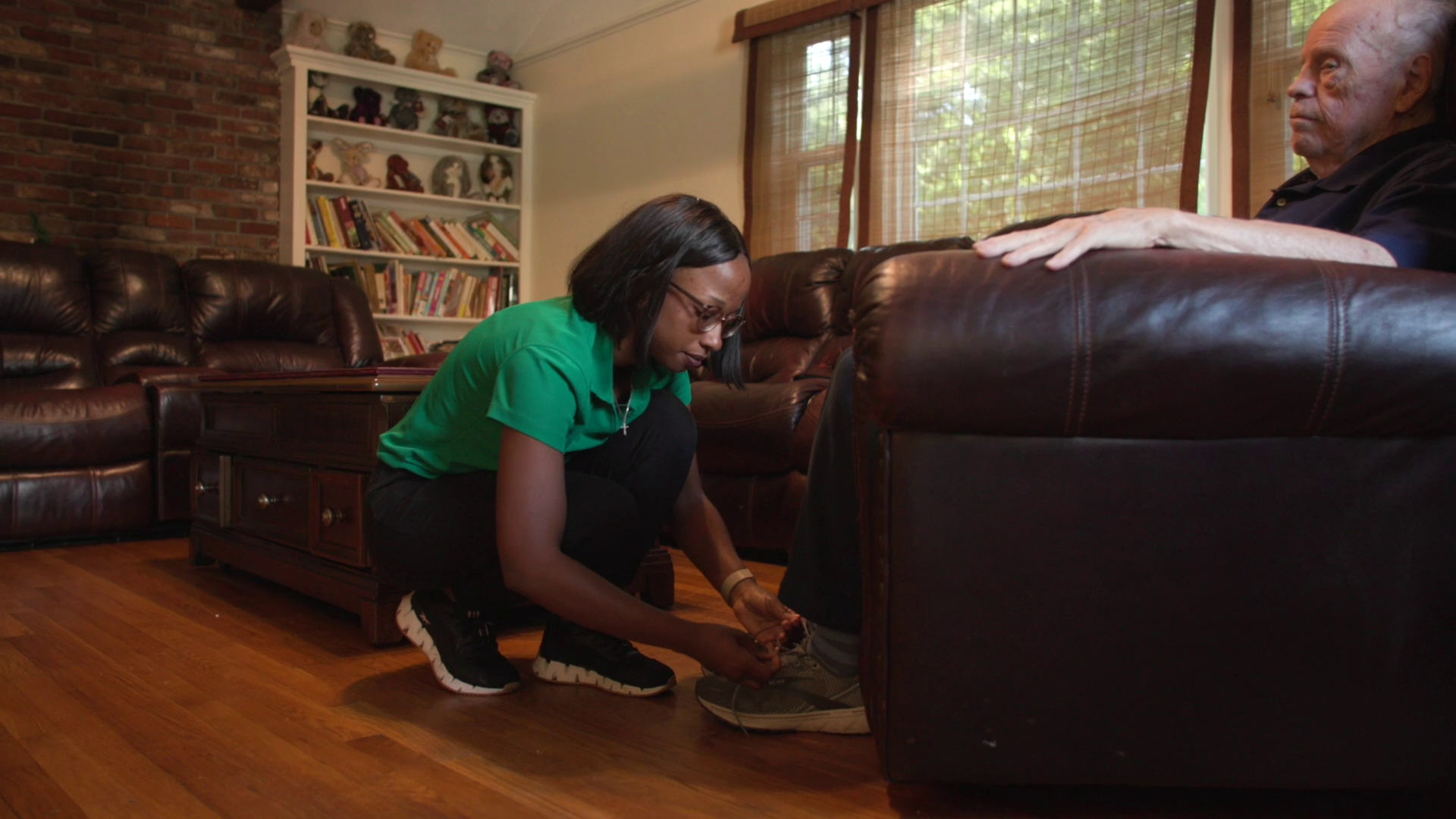
A home health aide can provide the one on one supervision, help with positioning and transfers, bathing and dressing, mealtime assistance following the plan the family and the feeding therapist set, and can be the second pair of hands that makes the therapist's home exercises actually happen between visits. An aide can also be the adult who stays with the child so a parent sleeps, or goes to work, or spends an hour with a sibling.
An aide cannot give medication. Our aides are trained, background checked and insured, and they are not nurses. Seizures are common in Rett syndrome, and if there is a rescue medication in the house, administering it is a nursing task or a parent task, not an aide task. The same is true of tube feeding. If your child needs either of those covered during a shift, what you need is nursing hours, and that is a separate service at a separate rate. Any agency that tells you otherwise is telling you what you want to hear.
What does transportation look like for a young child?
A young child rides in their own properly installed child restraint, and we expect a parent or guardian to ride along. Wheelchair transportation with a ramp and a four point tie down is what we do for a passenger who stays seated in their own chair, which for a child with Rett syndrome may be years away or may be now, depending on walking and on the size of the chair. Tell us which situation you are in when you call, because it changes the vehicle.
A wheelchair van with a ramp and a four point tie down, for a passenger who stays in their own chair.
Wheelchair transportation is $115 each way or $230 round trip within five miles of one of our offices, then $2 a mile. If the house has front steps and no ramp, two staff and a motorized stair chair are $200 a visit .
What does the home help cost?
Home health aide care is $45 an hour, one to eight hours a day, with no minimum contract and no assessment fee. An overnight is $540 for a twelve hour night. Most agencies in Massachusetts will not take you for less than four hours a visit or twenty hours a week and will not put a price on their website. We will do three hours on a Tuesday if three hours on a Tuesday is what you need.
Who else should you call?
- The Rett Syndrome Association of Massachusetts. Parents who are ten years ahead of you and who know which clinician, which chair, which school district fight is worth having.
- Massachusetts Family TIES. The state's parent to parent network, which will match you with another family.
- The Rett Syndrome Program at Boston Children's Hospital , if you are not already connected to it.
- Your neurologist , about treatment. There is now an FDA approved medication for Rett syndrome for age two and up. Whether it fits your child is a conversation for the neurologist, not for us.
Where do you go and what do you need to tell us?
We work out of Woburn, Brockton and Springfield and cover most of eastern and central Massachusetts. Call 781-957-8076 . Tell us the child's age, what a normal day needs, whether there is a rescue medication or a feeding tube, and which hours you are trying to cover. If we do not have the right person available for a child that young, we will tell you that on the phone instead of sending somebody who is not a fit.
This page is general information about arranging care and transportation in Massachusetts, not medical advice. Follow your child's clinical team.
Share