
ADLs and IADLs: What They Are and Why the Count Matters
Somebody at the hospital asked you how many ADLs your mother needs help with, and you did not know what that meant, and you guessed.
That guess matters more than anybody told you. The ADL and IADL count is the number that decides whether a long term care policy pays out, what a state assessment scores, what hospital discharge planners recommend, and how many hours of care a family actually buys. It is the closest thing this field has to a common language, and most families meet it for the first time in a corridor, under pressure, with no idea what is being asked.
Here is what each one looks like in a real house.
What are ADLs?
Activities of Daily Living are the basic physical tasks of keeping yourself alive and clean. They are the things you learned as a small child and stopped thinking about.
The standard list has six, and it comes from the Katz Index, which has been the reference tool since the 1960s. When a clinician says "two of six," this is the six they mean.
- Bathing. Getting in and out of the shower or tub and washing safely. In practice this is the one that goes first and the one families notice last, because nobody announces that they have stopped showering.
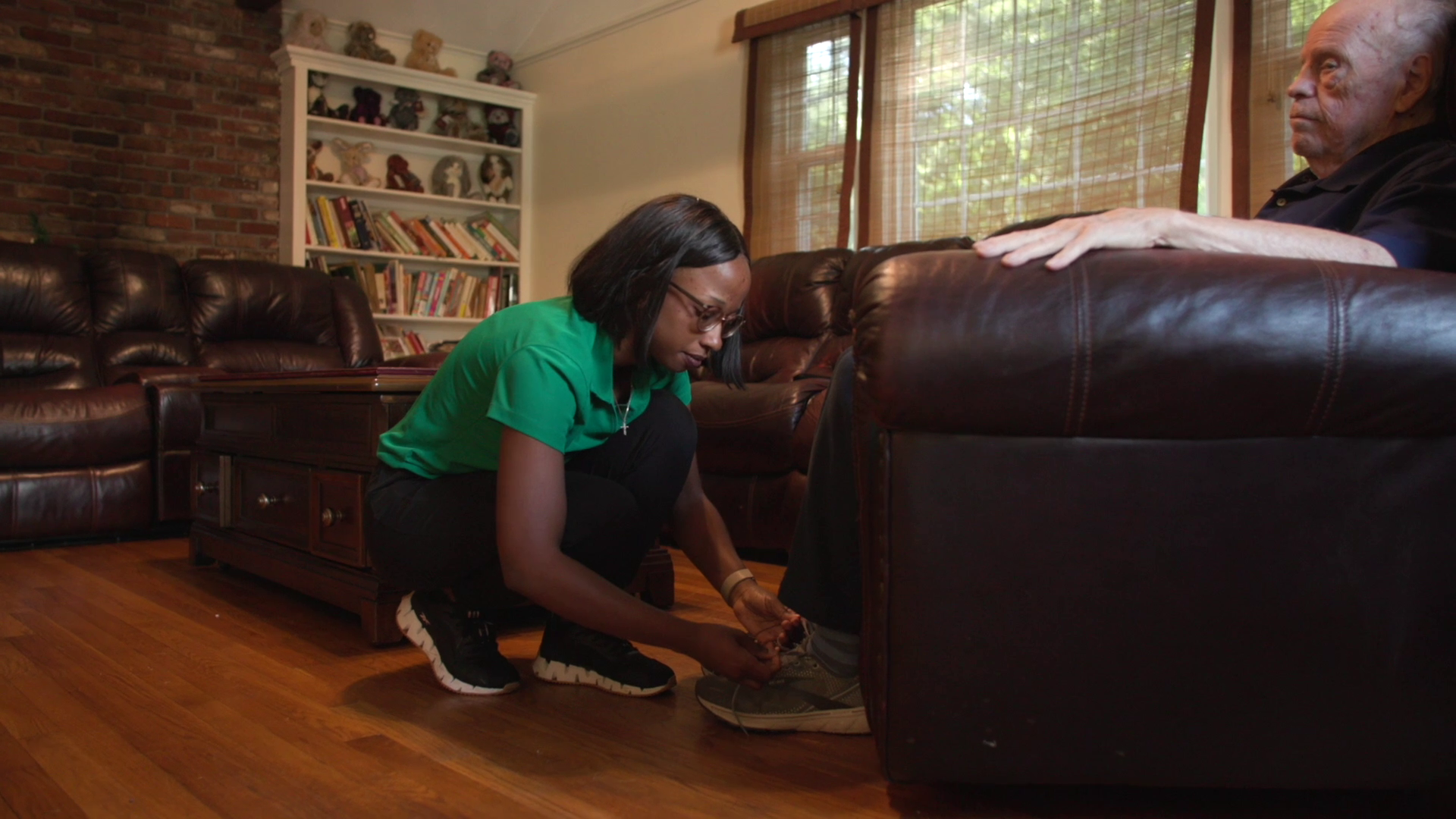
- Dressing. Choosing clothes and putting them on. Watch the feet. Socks, shoes and fasteners fail well before shirts do, because they need bending and fine motor control at the same time.
- Toileting. Getting to the toilet, using it, and cleaning up. This is the one people hide hardest, and it is the most common reason overnight care starts.
- Transferring. Moving between bed, chair and standing. If your father rocks three times to get out of the recliner, or pulls on furniture, that is a transfer problem even though he is still walking.
- Continence. Controlling bladder and bowel. Note this is about control, not about whether somebody helps in the bathroom, which is toileting.
- Eating. Getting food from plate to mouth. Not cooking it, which is a different category. A person who cannot cook at all may still score as independent in eating.
What are IADLs?
Instrumental Activities of Daily Living are the tasks of running a household rather than running a body. They need planning, memory, judgment and dealing with the outside world.
The standard list has eight, from the Lawton-Brody scale.
- Managing money. Paying bills, banking, not being taken advantage of. Unopened mail and a shut-off notice on a person who has plenty of money is the classic first sign of all.
- Managing medications. The right pills at the right time in the right amount. The pill organizer that is still full on Thursday, or already empty on Tuesday, tells you everything.
- Preparing meals. Planning and cooking, not just eating. Someone living on toast and tea is failing this one even though the kitchen looks fine.
- Shopping. Getting to a store and buying what is actually needed. Look for seven jars of the same thing, or a fridge with nothing in it.
- Housekeeping. Cleaning and tidying. Not clutter, which may always have been there, but new dirt. A bathroom that has not been cleaned in months.
- Laundry. Washing and putting away clothes. Frequently the first household task to quietly stop, because the machine is often in a basement.
- Transportation. Driving, or arranging and using another way to get somewhere. New scrapes on the car that nobody can explain belong here.
- Using the telephone and communicating. Making calls, answering mail, handling appointments. Missed appointments nobody rescheduled is the version of this families see.

Meals, laundry and housekeeping are IADLs. This is what most early home care schedules are actually spent on.
Why does the difference matter?
Because of the order they fail in.
IADLs almost always go first. They lean on memory, sequencing and judgment, which are exactly what early cognitive decline touches, and they are also the first things to go after a fall knocks somebody's confidence out. A person can be fully independent in all six ADLs, showering and dressing and walking without help, and still be in real trouble because the bills are not paid and the medications are wrong.
That gap is the single most useful thing on this page. The IADL stage is your warning, often by a year or more. The ADL stage is the crisis.
And most families do not act at the warning. They act at the crisis, because IADL failures look like ordinary untidiness and ADL failures look like an emergency. Somebody who stopped cooking in March gets help in November, after the fall.

Managing the phone, mail and appointments is an IADL, and it is one of the earliest to slip.
Who uses the count, and for what?
This is the practical part, and it is why the number is worth getting right rather than guessing at.
Long term care insurance. Most tax-qualified policies pay out when the person needs substantial help with at least two of the six ADLs, expected to last at least ninety days, or has severe cognitive impairment. Note what that means: IADLs alone usually do not trigger a policy. If your parent has a policy, pull it out and read the benefit trigger wording before you assume anything, and read the elimination period while you are in there.
State and ASAP assessments. Massachusetts programs are assessed on functional need, and ADL and IADL scores are a large part of what the assessor is recording. This is one reason those assessments ask what look like repetitive questions.
Hospital discharge. Discharge planners are deciding whether home is safe. ADL dependence is what pushes a recommendation toward rehab rather than home.
The VA. Aid and Attendance for veterans and surviving spouses turns substantially on needing help with daily activities.
And any decent agency. When we ask you what your mother can and cannot do, we are building this list, because it determines which hours to staff and what the aide needs to be prepared for.
How do you score it honestly?
Two rules, and families get both wrong in the same direction.
Score what happens, not what is possible. The question is not whether she could theoretically shower. It is whether she does, safely, without help. A person who can technically manage but has not washed properly in three weeks is not independent in bathing.
Count the help that is already there. If your brother drives her to every appointment, she is not independent in transportation. She has a brother. Families routinely score a parent as independent because the family is invisibly propping up four IADLs, and then wonder why everything collapses the week they go away.
The second one is worth sitting with. Write down what you and your siblings actually do in a week. That list is your parent's real dependency, and it is usually longer than anyone has admitted out loud.
What kind of help matches which stage?
IADLs only. A few hours, a few days a week, at the same time each day. Groceries, meals cooked ahead, laundry, a look at the mail, medication reminders, rides. This is a small schedule and it is enormously effective, because it removes the things that were quietly getting dangerous while the person is still perfectly able to run their own life.
One or two ADLs. Daily hands-on help, usually shaped around one window. Bathing means mornings. Toileting at night means overnight. This is the point at which an aide rather than a housekeeper is genuinely required.
Three or more ADLs. Substantial daily care, often twelve hours or around the clock, and the point where families should honestly compare home care against a facility. If any ADL need is skilled, meaning wound care, injections or a catheter, that is nursing, not aide work, and it is a different service.
One thing worth saying plainly: the IADL-only family is the one most agencies turn away. A four hour visit minimum and a twenty hour week minimum make a six hour week impossible to book, so people are told to call back when things get worse. That is exactly backwards, and it is the reason we run with no minimum contract.
Transportation is an IADL, and it is often the first one a family cannot cover themselves.
What does each stage cost?
Home health aide care is $45 an hour , one to eight hours a day, with no minimum contract and no assessment fee.
- IADL support, 3 hours twice a week. $270 a week, about $1,170 a month.
- One or two ADLs, 3 hours daily. $945 a week, about $4,095 a month.
- Full days, 8 hours. $2,520 a week.
- Overnight, 12 hours. $540 a night.
- Around the clock. $1,080 a day.
Wheelchair-accessible transportation is $115 each way, $230 round trip within five miles, then $2 a mile. Stair assistance is $200 a visit.
Where to start
Take the two lists above and mark each item independent, needs some help, or cannot do. Do it from what happened last week, not from what your parent says on the phone. Then count.
If everything you marked is an IADL, you have time, and you should use it rather than wait. If two or more ADLs are marked, the situation is already further along than it feels, and it is worth acting this month.
Care Remedy provides home health aide care and accessible transportation across eastern and central Massachusetts, with offices in Woburn, Brockton and Springfield.
Call 781-957-8076 and read us your list. You will get a price and an honest opinion on that call, including whether we think you need us yet. Email info@careremedyinc.com .
This article is general information about how these assessments work, not medical advice. For a clinical assessment, speak to your doctor.
Share