Can You Call the Fire Department to Lift Someone Up?
Somebody is on the floor and cannot get up. Or somebody is in the car outside their own front door and there are five granite steps between them and the hallway. And somebody in the family says what everybody says: just call the fire department.
There are two different situations hiding inside that sentence, and the answer is different for each. Here is the honest version of both.
If somebody has fallen, call 911
We want to be completely clear about this before anything else, because nothing below should make anybody hesitate for a second in an emergency.
If a person has fallen and cannot get themselves up, call 911. That is what the service is for. Do not spend twenty minutes trying to lift somebody yourself first, and do not let embarrassment, theirs or yours, delay the call.
Call 911 without hesitating if the person hit their head, takes a blood thinner, cannot move a limb, has obvious pain in a hip, shoulder or wrist, is confused in a way that is new, or cannot tell you what happened. Do not try to move them.
What a lift assist actually is
Most fire departments respond to what they call a lift assist: somebody has gone down, is not injured, and simply needs help getting back into a chair. Crews check for injury, get the person up, make sure they are settled, and leave.
It is a real and widely used service. Many departments have a written policy for it; Ann Arbor's is published online and is a fair example of how these calls are handled. Families discuss it constantly, including on AgingCare, where the answer is essentially that it varies by town.
So call when you need it. But understand what it is not.
Three things a lift assist is not
- It is not a scheduled service. You cannot book the fire department for Tuesday at ten because that is when the appointment is. Crews respond to emergencies; a planned trip up the front steps is not one.
- It is not necessarily free. Some departments have started billing for lift assists, particularly repeat calls. McKnight's Senior Living reported on the trend. Policy varies town by town in Massachusetts, so it is worth knowing your own before you need it.
- It is not a solution to the underlying problem. Repeated lift assists at the same address are a recognized warning sign, which is why fire and EMS services increasingly route those households into fall prevention programs rather than simply coming back. The National Council on Aging describes how those partnerships work.
If you have called three times this year, the honest read is not that you are a nuisance. It is that something in the house has changed and has not been addressed.
Find out your own town's policy now, not at midnight
This is a ten minute job and almost nobody does it.
- Call your fire department's non emergency line and ask two questions: do you respond to lift assists, and is there a charge. Write the answer on the fridge.
- Ask about a lock box. Many Massachusetts departments run a key box or file of life program so crews can get in without breaking a door. It is usually free and it is the single most useful thing on this page for somebody living alone.
- Ask your Council on Aging about fall prevention. Most run or can refer you to a program, and several have loan closets for equipment.
What never to do
Families improvise, usually out of love and usually at the worst moment. These are the improvisations that put somebody in hospital, and quite often it is the helper rather than the older person.
- Never lift somebody by pulling under the arms. It is the instinctive grip and it is how shoulders get injured, on both people.
- Never carry anybody up or down a flight of stairs in a kitchen chair, an office chair or a manual wheelchair. None of those are designed to be carried loaded, the wheels turn, and the person on the bottom step is taking the whole weight with no way to stop.
- Never do it with one person, and never do it with two people who have not done it before, on a turning staircase, in the dark, in the rain.
- Never rush the lift after a fall. Ask what hurts. Ask them to move each limb. Wait. The instinct to get somebody off the floor immediately is the instinct that turns a fall into a fracture.
The planned version of this problem has a name
If the real situation is not an emergency but a building, that is a different service, and most families never find it because they are searching for the wrong words.
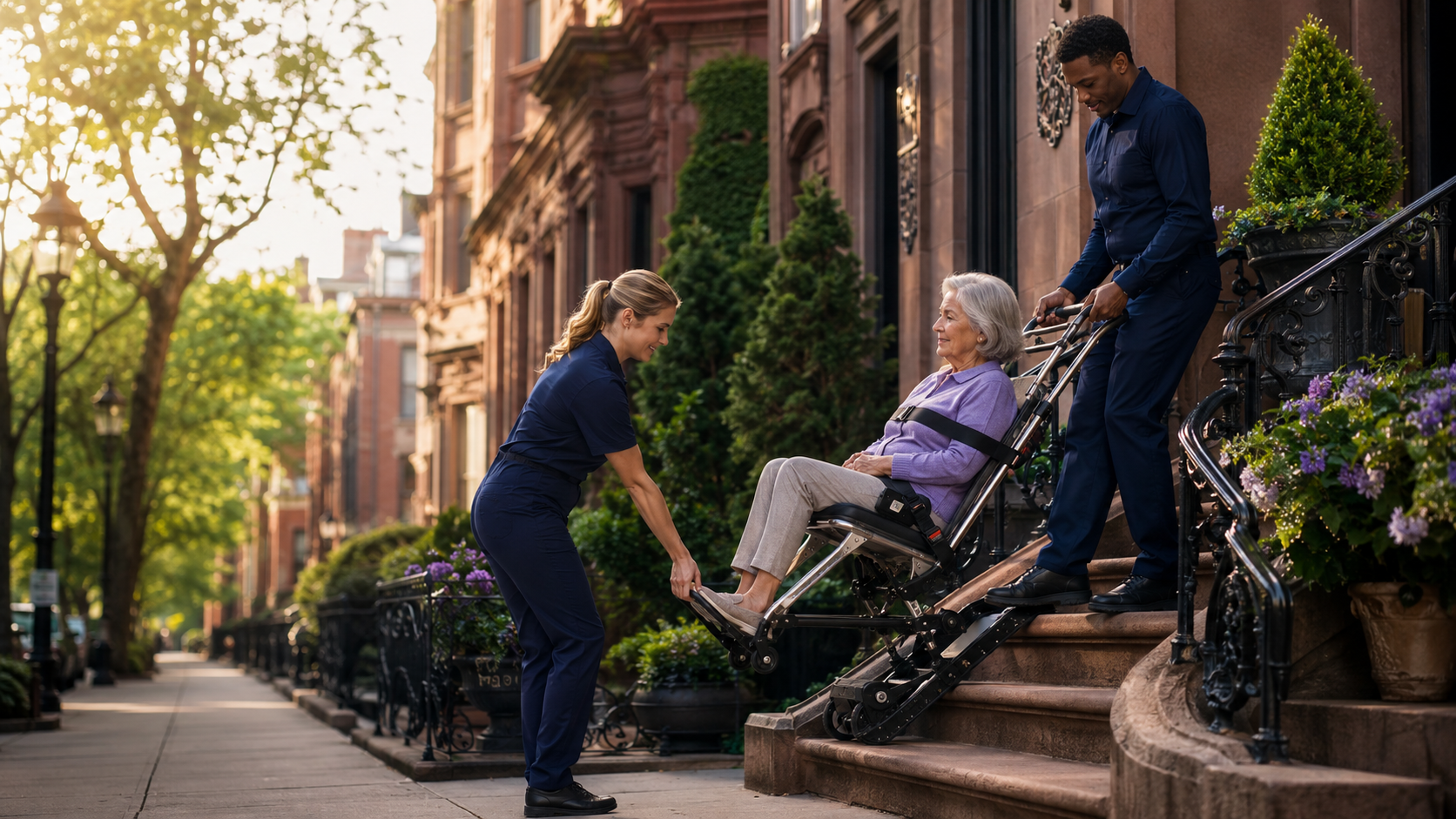
Stair assistance is two trained staff and a motorized stair chair, at $200 a visit. The person stays seated and secured. Nobody is carried, nobody is lifted under the arms, and nothing is installed in the building. It is booked in advance like any other appointment, and it is the right answer for the recurring version of the problem: the front steps, the discharge home, the third floor flat, the Sunday at a daughter's house.
It is also the right answer when the alternative is two family members deciding to have a go themselves. Here are the four real options compared honestly, including the ones that are cheaper than us.
And if this keeps happening
A person who is going down repeatedly is telling you something, and it is rarely about the floor. Most falls are never reported to anybody, so if you know about three of them there were probably more.
Worth doing, in this order: get the medication list reviewed, because several common prescriptions affect balance; get eyes and feet checked; and get somebody in the house during the hardest hour of the day, which is almost always the morning. Here is what else we would look at, in the order we would look at it.
Where to go from here
Two different problems, two different places to start.
- If the problem is the stairs or the front steps. Book stair assistance here, at $200 a visit with two trained staff and a motorized chair. Send a photograph from the bottom of the stairs and we can answer on the call.
- If the problem is the day itself. Tell us what the week actually looks like. Home health aide care is $45 an hour, one to eight hours a day, no minimum contract.
Care Remedy Inc, 100 TradeCenter Suite G-700, Woburn, MA 01801. Call 781-957-8076 . Home health aide care, wheelchair transportation and stair assistance across Greater Boston, with offices in Woburn, Brockton and Springfield.
Sources: National Council on Aging, partnering with fire and EMS to prevent falls · McKnight's Senior Living on lift assist billing · Ann Arbor Fire Department lift assist procedure. Our rates are current as of publication. Lift assist policies and charges vary by municipality, so confirm with your own department. This article is general information and is not medical advice. In an emergency, call 911.
Share